Showing posts with label the beauty myth. Show all posts

Sunday, October 08, 2006

Bodies the Size of Zero

I was scrolling through Feministing the other day when the post Doing the Unthinkable! caught my eye. While the point of the article is extremely interesting, I want to focus more on this comment made by Samhita:
Furthermore, how come nobody has mentioned the fact that a size 0 means it
doesn't exist. Zero means nothing or that it is not there, so in a way it is
like the metaphorical erasure of women, as though they don't exist or that they
don't take up any space. Just a thought.

A lot of the commenters, who are size 0 themselves, took offense to this. They thought Samhita was saying that they don't exist, or thought that she was bashing them to be size 0.

I hadn't noticed until fairly recently that clothing stores have been changing their sizes so that a larger size is size zero. Some of my friends were happy about this, telling me how they now could feel better about their bodies when trying to find a pair of pants. I don't see it this way. I feel that the sizing of clothes is arbitrary: I never know from store to store what size to look for, it's always grab at least three different sizes and head to the changing room. The new move for size zero, I'm sure, is a way for clothing stores to boost the self-esteem of their clientele so that they buy more clothes--the beauty of capitalism. I can't help thinking, and what Samhita was hitting on in her post, is that in our patriarchal society, being thin is best because when you're small you don't take up space or impose. We are taught to want to be small, petite, skinny because it's beautiful and healthy. There's a lot of different facts out there that can be conjured up that say that bodies that aren't thin are unhealthy and lazy. Our ideas of what is thin and what is obese has become dangerously skewed, for bodies that are perfectly healthy yet larger than what is acceptable have been called obese.

I've struggled particularly with that. My body isn't the same as it was when I was 18: I've put on weight, there's mounds where there were angles. I eat healthy, I exercise every day, and damnit, I should be happy with my body, because it's at place where it wants to be. Yet, that's hardly ever the case, I've internalized the beauty myth, and it's come to the point where I wonder if the yoga I do is for the health of my body or if it's to slim down, tone, or decrease in size. I want to be petite, I want to look like Buffy.

The new size zero wasn't implemented so that women are easier on our bodies, it was put into to place so that we buy new clothes. Whatever. The fashion industry will always be our friend and enemy. Samhita wasn't criticizing anyone for being a size 0, she was just trying to talk about the societal baggage that comes with the size. What I hope to do is to accept my body as it wants to be, and to accept all the different sizes that women are: it's not easy when anyone is seen as too skinny or too overweight.

Thursday, May 25, 2006

My Soapbox on Ethnocentricity and Maiden Love Revolution

I was scrolling through Feministing this morning when I came to this post. It speaks briefly about a game coming out in Japan called Maiden Love Revolution that features
the role of 220-pound Hitomi Sakurakawa as she struggles to slim down - mostly by restricting her diet. To advance, Hitomi must count calories and increase her exercise. The game keeps stats on her progress and ultimately rewards her conformity with a boyfriend.
I was struck by a comment that followed which stated "the Japanese are very strange people." I see this type of comment often (there's a lot of posts out there on the latest ridiculous game or what have you from Japan) and it really gets to me. Yeah, I post all the time on misogynistic stuff that irks me, and I'm not defending this game--particularly because of the subject matter, and also because it sounds boring and dumb. However, I want to point out that it's important to consider ethnocentricity, when criticizing or analyzing something from another culture.

I'm no expert on Japanese culture, but I know that there's a lot of different genres and categories that feature games that wouldn't fly here in the US. It's important to note that subjects like sex aren't viewed in the same way in Japan as it is here--we have separate cultures--but in the same breath, it's important to recognize that Japan is a patriarchy, just like the US. We might not make sex games or weight loss games, or promote such titles in our mainstream culture, but we're not innocent.

People are quick to judge other culture's problems, which turn out to be similar to the problems that we have. (See: cultural relativism.)

UPDATE: Lake Desire over at New Game Plus makes some great points about the premise of the game, one being that it stigmatizes overweight people from dating.

Monday, February 20, 2006

Gender Norm Violation


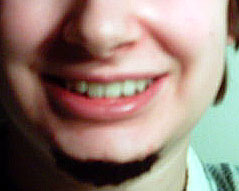
1) I chose for my gender norm violation to have a goatee. I had a hard time figuring out what to do for the presentation, but knew that I wanted it to be something that was specifically appearance-based. I have always been aware that as a woman a lot of things are based on how I look, such as what kind of person I am. I have a friend who took a class in theatre make-up, and he offered to give me a goatee, since facial hair on a woman is something that is definitely not seen every day, yet we are all familiar with the carnival stereotype of “the bearded lady.”
2) I believe that facial hair is seen as a sort of rite-of-passage for men. Boys in high school who can grow thick facial hair are seen as more mature or manly. Old men with facial hair are sometimes thought of as having wisdom, and we have the old Bible story of Samson and Delilah, with Samson losing his power because Delilah cut off his hair. Women have narrower faces without facial hair, thus they take up less space. And as I’ve I mentioned before, there’s a lot of pressure on women to be pretty or feminine-- often to the point where it’s distracting. It can take up a lot of a woman’s time. I think it can be argued that this keeps women regulated to a certain place that isn’t as strongly related to power or even wisdom in our society. Furthermore, since we see men and women as very different, we expect certain physical aspects not to be same and facial hair is definitely one of these. A woman who has facial hair is seen as weird or as a sideshow freak. She may also be seen as butch—not as a true woman in a sense of the word.
3) I hypothesized that when I went out with facial hair that a few people would stare at me, that others would look away, and that some people might laugh, albeit nervously.
4) I chose to do my norm violations a) during the day on Michigan Avenue, where a lot of tourists would be b) during the day at a Bank, which would be an office-type setting c) At night at K-Mart, in my neighborhood which is more or less made up of people from the lower middle class and below and d) at night at a Whole Foods in Lincoln Park with mostly middle and upper middle class people.
5) At each place I tried to conduct myself like I normally do. On Michigan Avenue I walked around while window shopping, at the bank I had a check cashed and at K-Mart and Whole Foods I made some purchases.
6) The whole time when I wore the goatee I felt uncomfortable. I noticed that I looked down at my feet a lot when I was wearing it, and that I didn’t want to look people in the eye. I felt ultra-sensitive in that I feared that people were judging me. I felt relieved when I could finally take it off. I know that I felt this way because I’ve internalized the norm that women who have facial hair should get rid of it. I felt that with facial hair, I didn’t look attractive or like a normal person, instead I felt like I was actually breaking a rule.
7) Most people did a double take when they saw me. At first I don’t think they quite believed that they saw a woman with facial hair. Some people grimaced, while others, maybe because I was with my friend who is male, looked at us with visible disgust (because we might have looked like a same sex couple). No one said anything outright to me, however. It felt, however, that there was a purple gorilla in the room and everyone was doing their best to ignore it.
8) What this exercise taught me is that gender norms are deeply ingrained. I didn’t think I would personally have such a hard time walking around with facial hair for a school project, but it really did bother me. It gives me admiration for those women who do choose to have facial hair, but I don’t blame other women for wanting to be rid of theirs. I think we like to think of appearance as something that is trivial, but I don’t think it is. Appearance goes hand in hand with gender expectations, which dictates that men and women to look differently. This expected differentiation is a result of patriarchy, but I believe that it also furthers this system because it helps us believe that men and women are inherently different. This in the end can therefore make it more difficult for us to achieve a more egalitarian system.

Monday, November 07, 2005

Political Hair and Feminist Thought

I'm trying to write a cohesive essay for my creative nonfiction class on hair (leg hair) and feminist thought. It also includes androgyny, Disney characters and Jennifer Aniston. I'm try to view the piece sort of as a blog entry, instead of going at it from a Poetry Major's viewpoint, but I'm having a hard time. I wish I could just write a poem. Here's a rough little excerpt:
Androgyny is as fashionable as being a rebel. I wanted to be a white wall: indistinguishable with a plain face and body. What I really wanted to do was to relive a grade school memory: walking to my grandma’s house after a sweaty game of softball in a pair of white polyester pants that hung loosely around my hips, black Nike cleats, a large blue t-shirt that read Coldwell Banker across my chest. My hair was tucked up inside my red baseball cap. Walking along, I stared
at the grass, hitting my metal bat on my toes every step or so. Two boys walked by, but I didn’t bother looking at them. I heard one boy talk to the other in a low, cautious voice. “Was that a boy or a girl?” I was thrilled.


Here are some of the essays that I'm going to refer to in order to try to organize my thoughts:
  • John Berger, Ways of Seeing
  • Naomi Wolf, The Beauty Myth
  • Zones, "Beauty Myths and Realities and Their Impact on Women's Health" (the first part of the name is cut off on my xeroxed copy)
  • Bell Hooks "Sisterhood: Political Solidarity between Women"