Showing posts with label anime. Show all posts

Tuesday, June 12, 2007

Paprika: Not just for Deviled Eggs

If you ever watched the A-Team, you might remember the episode where Murdock becomes a chef and keeps asking for paprika. Because of this, it became the funniest and best spice in my mind. Now I have a new reason to love it that blows the A-Team reference out of the water, a feat that I would not have thought possible. The new Sotoshi Kon film, Paprika, was oh so yummy. I was able to see it in the theater this weekend and it was a dream come true. Paprika takes a wonderful, surrealist look into humanity's desires and the collective unconcious, but lacked any of Breton's misogyny.

Almost all of Kon's work, like surrealism, adds the fantastical into a realistic setting. The concept of Paprika allowed him to fully realize this idea. Kon understands the freedom animation allows and creates something truly unique. I found it bizarre how the morphing images and situations of the dreams made as much sense to me as the "real world" scenes of the movie. That dichotomy was questioned, and subsequently became very unstable. This continued with the characters. They straddled the line between being both archetype and fully humans. There were a definite struggle between the characters in achieving the ideal role for their gender or place in the world.


*Spoilers Below*


In Paprika, Kon gives us another strong female protagonist, and in this case, a superhero as well. The character known as Paprika exists to help people deal with their desires and guides them to think outside of archetypal roles. In this way she comes to represent the concept of the "woman of your dreams,"and in the sense of a super hero, she seems to be perfect. However, Paprika and her real life counterpart, Dr. Chiba, struggle with a Clark Kent/Superman relationship throughout the film. Paprika is everything Chiba isn't, which includes being in full control of her life. By the end, Chiba faces this, and the chief issues of film--which also includes many archetypes, such as technology vs. nature--are resolved by the creation of a new order, where the male archetype of aggression and dominance is defeated by the female archetype of growth and peace. Or to speak in other elements, light conquered shadow by consuming it.

There is one disturbing scene that needs to be addressed. Not to spoil too much, but at one point Paprika is captured and is symbolically raped. A colleague tears off her Paprika form and reveals her true identity beneath. Personally, I'm weary of rape scenes, and feel that popular entertainment is too quick to feature it, often without giving thought to the consequences. This was far from my favorite scene in the movie, but I feel the key word is that it is symbolic. By having the act be represented by something else, it leaves the action in the realm of thought, and forces us to think about rape. I'm not saying that this is any less powerful, or less potentially offensive and dangerous. I just feel in this context that the scene was meant for us to look at rape as a tool of the male aggressive, violent, and controlling mind set. It was not glorified or glamorized, but rather focused on the thought behind the act. The character responsible for the act pins Paprika like a butterfly in a room full of pinned butterflies. This speaks of the "male" desire to control and tame, and how patriarchy places women on the same level as an inset, or an animal that is easily manipulated and controlled. He does not think of her as human but as an object that should be displayed. The archetypal male mind set is further explored when Paprika is rescued by another colleague that is in the process of dreaming about being a male action hero. To him, Paprika is a precious commodity that needs his protection. His view of her is still in the same vein as the rapist's--she is still an object, the two men just disagree on her use. His parody is complete when he take Paprika to the ending scene of his dream that is complete with him posing before the setting sun, as he, the quintessential hero, cradles her in one arm and a smoking gun in the other. He then proceeds to claim his prize by kissing her as she droops unconsciously. This was received by a "how dare you" slap on the face, and the scene ends. After this interlude, Paprika reclaims the movie. Overall, it was a scene that I would have been happier without, no one likes to see a superhero, specifically female superheros, debased in such a way. However, I also don't think the scene was there for shock value or as a form of punishment, which are some of the reasons why rape scenes are told in popular entertainment. Rather, I feel it's purpose was as a tool of discussion. The way that it was produced confirms that. It forces us to confront the mind set that causes rape, and that is one of the first steps in preventing rape.

Monday, October 02, 2006

The 5th Carnival of Feminist Science Fiction and Fantasy Fans

Photobucket - Video and Image Hosting

Welcome to the fifth edition of the Carnival of Feminist Science Fiction and Fantasy Fans! We have a full plate to offer you: from G4 to Wizard, and from princesses to perverts.

Comics

First up, Jenn revisits an old debate between Ragnell and Scipio in her post Sexual Dimorphism and Feminism and looks at the scientific position on sexual dimorphism in the human brain. She notes


Fundamentally, I and other feminists must adapt our philosophy to incorporate the findings of science, and vocalize the fact that science cannot and should not be used to justify unequal treatment.

Over at Snap Judgements , Carla laments Joss Whedon’s impending run on Runaways by bringing up examples of his treatment of Kitty and Emma in Astonishing X-Men. In Unscrewing the Inscrutable, Marionette makes someone at Marvel take a moment to think. Jeremy versus the X-Men and finds a link between comics and being a stay-at-home-dad. And jlg1 looks closely at Pantha in Nobody helped me. Nobody cared.

Soyoerika discusses breast physics, bras and Arisia over at Zamaron:


Brothers and Sisters, I invite you to join me in a round of boggling at this
so-called character design. While I can buy the impracticality of the eighties
outfit, I simply cannot wrap my brain around the current outfit at all.

To go along with this, Kalinara offers up her analysis of Manly Men and Buxom Babes. Meanwhile, Ragnell studies Black Panther and Storm’s first fight as a married couple. She also covers for us the sexist trainwreck known as Wizard Magazine’s “How to Draw” series and the reactions from the female superhero fan community found on livejournal.

We’re all holding our breaths waiting to see who’s going to be cast as Wonder Woman, and Amy Reads over at Arrogant Self-Reliance is no exception. While many of us have an inkling of who we’d maybe want to see, Amy’s main concern is that the actress cast demonstrates the wonder of her namesake.

Web Comics

Though she’s been a fan of Scott’s Kurtz’s PvP for awhile, Robyn discusses her hesitation of remaining a regular reader in her post In Which I am Annoyed by PvP.

Also, make sure to check out how to draw comics the Planet Karen way.

Writing

Cassiphone, at Velvet Threads writes of the camaraderie and literary experience that she encountered after sending in a story to Fantasy and Science Fiction for the Slushbomb. Racy Li wonders why there isn’t and makes her case for there to be more of a connection between science fiction and erotic romance in Erotic Romance: Science fiction’s forgotten stepsister. Malachi explores the relationship between fiction and feminism by looking at the “princess syndrome” in fantasy. In the post On Cartography and Dissection, little light writes beautifully about being the Other.

Video games

Baring all about her love for video games, Blitzgal interprets the implications and frustrations about being a woman gamer, and gives a few helpful suggestions on how games could be better in her post But why do her boobs have to jiggle like that? And at her blog, Wonderland, Alice gives a run-down of Games for the Ladies. Lake Desire points us over to Fiona Cherbak’s piece, the Game Industry’s 100 Most Influential Women and also directs attention to some of the misogynistic elements in the ever-popular Katamari Damacy.

On the feminist gamer livejournal community, tekanji asks for input on how to measure feminist elements in video games. At Old Grandma Hardcore, Tim writes about Grandma’s semi-disastrous appearance for a discussion on women gamers for G4’s Attack of the Show. Bonnie Ruberg asks if there is there a gender divide in the narratology vs. ludology debate.

Television

In Life on Mars: Isn’t that where men come, BetaCandy gives us the goods on BBCAmerica’s show, Life on Mars. Good (as in feminist), it ain’t:


The minute a young woman with stereotypical prettiness gets a closeup, I know
she’s either going to get hurt or get laid.

Mickle, over at The True Confessions of an Hourly Bookseller identifies the Women in Refrigerator syndrome in the Season 2 of Lost. Beware the spoilers! Desdenova takes NBC’s new show Heroes to task for the poor treatment of its two token female characters. Sageness posts her thoughts and discussion with thete1’s about gender and race in Stargate Atlantis.

Photobucket - Video and Image Hosting

Anime

We only have one anime-related post for this edition of the carnival, and it’s about a subject that’s near and dear to my own heart: Cattygurl discusses some of the Kick-ass Women of Anime.

Reviews

Martin guides us through Ursula K. LeGuin's young adult novel Voices. Sleestak informs us about Shanna the She-Devil by Tony DeZuniga at Lady, That’s My Skull. Cassiphone looks at the female protagonists of Kylie Chan’s White Tiger and Tim Pratt’s True Adventures of Ranger Girl. And Heidi Meely gushes about Virgin Comics’ Devi.

Megatrouble rebuts Thomas Disch’s claim “that Mary Wollstonecraft Shelly and Ursula K. Le Guin’s contributions to science fiction are overrated” in her post Shelly, Russ, and Le Guin: How to Hide the Canons; Or, What Could Have Been a Really Fun Party if Not for Thomas Disch.

Photobucket - Video and Image Hosting

The Harlan Ellison Incident

The feminist SF fan community acted in outrage when Harlan Ellison groped Connie Willis at the Hugo Awards. In response to the incident, Kadymae writes her manifesta Nice Girls Don’t… in which she states


if it had been me up there on the stage at the Hugos and Harlan Ellison put a hand where it didn't belong, at the very least he would've been shoved away and asked, "What do you think you're doing, asshole?"
Yonmei points out that Harlan Ellison has always been a sexist creep. Lis Riba reported on the whole incident herself and asks, “What does a woman have to do to get a little respect in this industry?"

Fandom

Peaseblossom, in her post How Much XP for a Blow Job? discusses the sexism that some women have to endure just to play a game:
Telling someone (or implying it, or complaining about it to a third party) that
she gets special treatment from the gm because they're romantically involved is
as adolescent as it is sexist.


Becky encounters in her post Hey, didn’t I used to write for a website called GeekGirls? Time Out New York’s idea of nerd girl, or rather, the NILF.

Melody Kitty loves being a fangirl, but she’s sick and tired of the objectification and depowering of superhero women. In another post, she challenges the geek fan community as a whole to stop stereotyping and be more observant of women within the community. Similarily, Willow wonders how we could open up dialogue with fanboys away from stereotypes to prove that we care about female characters in If The Fanboys Think We're Jealous, How Do We Win?

And last but not least, make sure you swing by Ladyjax’s blog, she’s holding a call of submissions for Boom Tube: a zine about Race, Culture and Fandom. Issue one’s theme will be dedicated to fans of color focusing on their experiences.

Photobucket - Video and Image Hosting

Thanks for reading! Mark your calendars; Revena at The Hathor Legacy will be hosting the next carnival on October 16.

Tuesday, May 09, 2006

Weekend Without Shame


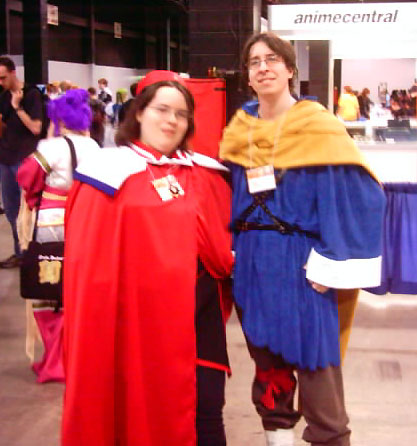
Was I studying for my finals this weekend? Hell no, I attended Anime Central on Friday and Saturday.

Brief Observations:

--Genshiken is a beautiful and interesting anime--I don't see it as simply a look at the "otaku lifestyle" of Japan, it's a study of masculinity for young men that aren't traditionally masculine. Definitely brings up difficult issues (like hentai) and good questions, with a backdrop of superb animation and humor.

--There seemed to be even more cross-playing this year. Lots of young teenage boys dressed up in Sailor Moon and Kagome costumes, very cute.

--I attended a shonen-ai panel: I really can't get into shonen-ai, but I learned a lot, specifically the differences between the perspective of western audiences versus eastern audiences. The best part was when a young gay man stood up and spoke out against top/bottom relationships--saying that they're insulting to homosexual relationships because such pairings are reduced to sex, and that they evoke traditional unhealthy heterosexual relationships where all power is placed on the masculine. (He received lots of applause from everyone at the panel.)

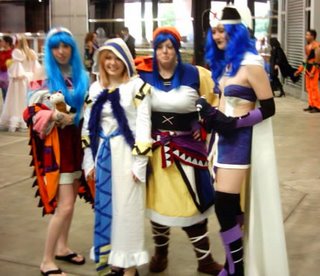
--I saw lots of Lunar cosplayers!

Saturday, April 22, 2006

Today is Blog Against Heteronormativity Day

Remember to check out blac(k)ademic for her post and for links to the other blogs that are participating.
Heteronormativity is everywhere and is everything. That is an understatement. I think what gets me the most, however, is how even the things I turn to for relaxation or a bit of catharsis end up putting me into the same mental place in which the real world takes me. It's another understatement when I say there is an extreme lack of queer people in the geeky culture I take refuge in.


Which is why the anime series Revolutionary Girl Utena has been so important to me.

I could write an essay about the show and the characters and how it refreshingly spins heteronormative fairytales on its head, but I think it's more fun to read this poem that pretty much demonstrates what it means to me.

Utena Dances the Wedding

If the egg’s shell does not break,
I haven’t been to the Riviera since high school prom. This time, however, there were lilies and white carnations in revolving[1] chandeliers.
The chick will die without being born.
Chocolate covered strawberries on pink[2] china plates. Does the merlot color my lips or is it my mother’s lipstick?
We are the chick; the egg is the world.
I step on Uncle Ed’s shiny shoes. After the song (Mercy, Mercy, Mercy) he bows, says “I must return to my wife now.[3]
If the world’s shell does not break,
His wife is Carrianne[4]. Health problems. (Never knew what?) Now ordained. Was Catholic, maybe not Catholic anymore.
we will die without being born.
Betty wears new Nikes under her wedding dress. I saw it so under the bathroom stall. I think of her at Payless buying cross trainers[5] just for dancing.
Break the world’s shell!
The last time I was at the Riviera, Aran and I danced all night. Specifically to Sting’s “Fields of Gold[6]”. I dance with Betty during “Twist and Shout.”
For the sake of revolutionizing the world!
The sweat of her neck was like another string of her pearls. The sweat on my neck: bad lighting. Betty shakes her hips towards mine and whispers[7], “One day it will be just like this for you.”

-------------------
[1] In the opening of Revolutionary Girl Utena, Anthy and Utena revolve on the face of a blossomed rose.

[2]Pink, the color of Utena’s hair is said to represent her immaturity, her ability to trust others.

[3]Now you should have nothing to complain of.

[4] Blood type B people also love to be complimented; yet they are kind to all others and show genuine concern for friends.

[5] Notably, Utena’s uniform consists of a boy's black jacket, and red biker shorts. Anonymous girl says, “Utena-sama came in drag?! How cute!”

[6] In the movie adaptation, Utena and Anthy dance in the flooded rose garden, beneath a CG-rendered sky.

[7] "Though you pose as a prince, in the end you're just a girl."

Friday, March 31, 2006

Is She or Isn't She?


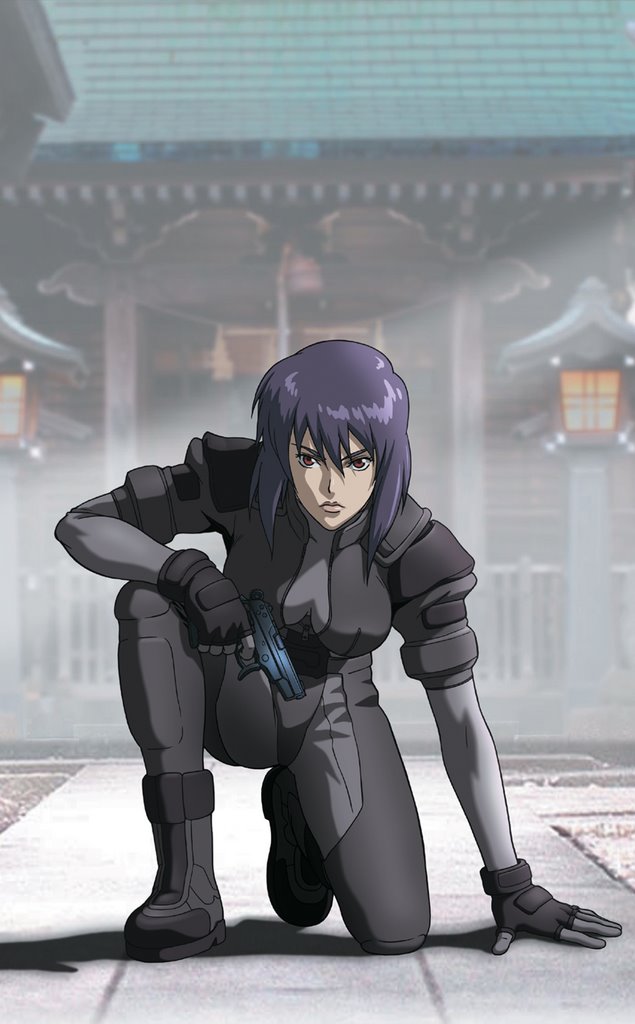
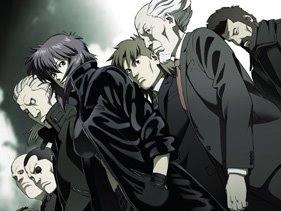
Is Major Motoko Kusanagi a progressive female protagonist or a femme fatale designed for male titillation?

There are three Majors: one in the manga, one in the two movies, and one in an anime series. Each are separate of each other. I'm focusing on, for the purpose of this blog entry, the Major Kusanagi of the anime series Ghost in the Shell: Stand Along Complex (along with the second season GitS: SAC 2nd Gig.) Warning: I'll be discussing some details of a few episodes, so some spoilers are ahead.

When I initially began watching this show, I was pretty damn excited. The Major is a kick ass character: she's smart, strong, leads a group of men and is vocal against sexism. She never needs to be saved, in fact she's the one usually "saving the day." I've never seen her fawn over, or kiss a man--in fact the most pseudo-romantic scenes that have been portrayed with her have involved women. (It's generally accepted that she's bi.)

But then there's the matter of her clothing: thigh high boots, a pink leotard that cuts up above the hips and dips deeply into her cleavage. Her breasts, are they C or D? I'm not sure, but you can't help but notice them. In general her body is perfect. A drawn fashion model.

However, it's more complicated than that. Her body is completely prosthetic. If we are to take the episode 11 "The Grass Labyrinth -- AFFECTION" as her origin, we know that when she was young she was in a plane accident and the only way that she would live is if she underwent cyberization. This makes her whole body "fake." What does gender mean when you don't have a body? There are references to her gender through out the series. An important one was when Batou asked the Major why she chose a female body over a male body--a question she doesn't necessarily answer. Instead she mind-hacked him into punching himself in the face. What I can gather from this is that the Major is expressing that she doesn't need a pumped-up male body, that her own "female model" is just fine, and that the topic really isn't up for discussion. It's obvious that the Major takes pride in her body; it's the ultimate weapon that provides her income, it allows her to be mobile, and it lets her experience the five senses. Does she dress the way she does as a way to promote that her body because she takes great pride in it? Does she dress that way in order to feel feminine because her body is made out of machinery?

These were questions that I could ponder over without ever questioning that to me, the Major was a feminist hero. Yet, when I watched 2nd gig last Saturday, episode 17 "Mother and Child -- RED DATA," I became unsettled. Could I really claim her as my hero? Was she only created for the sake of fan service?

The premise of this episode is that the Major comes across a teenage boy while digging up information on a suspect. She then takes the boy under her wing because he's in trouble with the yakuza. This includes her renting out a hotel room for night. In this scene we watch the Major walk around topless with a red towel hanging around her neck. This shows no nipple but plenty of side-boob. She talks to the boy in this manner, and gets in bed with him like this.

We've seen the Major is various states of undress before but I always chalked it up to a) her loving her body or b) her not feeling as though she's really naked because her body is artificial. The images from this scene, and her teasing answer of "Do you want to find out?" to the boy's question of whether or not cyberized bodies could have sex made everything seem a bit much. The mocking answer to the boy fit in with her character, but all the boob shots seemed to be completely gratuitous.

I've decided for myself that the character of the Major suffers from being written by too many male writers that want to please their predominantly male audience. (Look, Kusanagi kicks ass, just look at how she handles those guns, and she's really hot too!) I think in regards to the Major, we can have interesting discussions on gender and artificial bodies and the concept of nakedness, but we become limited with the proliferation of fan service--which focuses only on one kind of expression that exists to serve male heterosexuality.

It's good that it's not easy to discuss the character of the Major. It means that she's a complicated character, and that some time and energy has gone into writing her. I'm just disappointed that she's being used to promote the mainstream ideal of what feminity is. I know I wouldn't be typing this up if she was a male character (the issue of fan service wouldn't be happening)--but if she was a male character, I know I wouldn't be interested. I want to claim the Major as a representation of a progressive female protagonist, but do the sexualized representations of her negate the positive aspects of her character?