Friday, June 29, 2007
Why do you hate me Sony?

Monday, June 18, 2007
Changing of the Green Guard
I can smell this happening again and soon to one of my favorite books out there. I was stunned about how good She-Hulk actually was and took it upon myself to pick up all of the back issues and danced when I found the trade paper backs. It wasn't a perfect run, but the comic was unique, refreshing and fun. It revitalised my love for comics after reading countless clones of over-the-top dramatic comics. But now Slott is leaving to write Spider-man, a character I like, yet I find She-Hulk to be much more interesting and in greater need of good writers.
Slott's replacement is Peter David. I know that some might think having the guy who wrote He-Hulk for longer than I've been alive to be a good thing, but I just can't help but worry. I have my doubts that he can maintain the greatness of the book, and I know for a fact that the tone will be different. For instance, the postmodern jabs at comics and Marvel will be MIA. Marvel is lacking in great female super heroes--they need everyone they can get--and I feel that we're going to lose one more. (RIP Jean.)
Monday, June 11, 2007
Whaddya mean there’s no She-Hulk?
I was petty happy with the variety of characters—the most comical team that we put together consisted of Venom, The Thing, Hulk, and Ms. Marvel. But I do have some nitpicks:
--First of all, why were the starter characters specifically chosen? I understand the need to keep the pool small in the beginning as there is a slight learning curve, but I still think they could have given some leeway. I really wasn’t feeling it with the Thor, Spidey, Captain America and Wolverine team up.
--I’ve said this before with X-Men Legends II and I’m saying it again. I think there could be more female characters. I don’t see why there can’t be some gender parity. Moon Knight is in there, but no She-Hulk? Raven, you break my heart. (We have history.) With characters such as the ones I mentioned above, it’s not like they’re hurting for some character recognition. And I say this because it’s often argued that women characters are not used because they’re not as well known by the general public.
--That said, I think it would be fun to have some more B-List and obscure characters. Perhaps as unlockables?
--The storyline, though specifically different from X-Men Legends II, felt exactly like X-Men Legends II. I enjoyed the first X-Men Legends because it focused on a specific character; it didn’t feel too large or generic.
--The character animations are still awkward, and this same problem has plagued this franchise since the beginning. Though small, and not integral to the overall enjoyment factor of the game, I thought it’d be addressed, seeing that I was playing this on a 360.
--Last but not least, for whatever reason, I had trouble distinguishing between friend and foe while fighting. I might need to sit closer to the TV screen.
Tuesday, June 05, 2007
MiPOesias: The David Trinidad Issue #2
Tuesday, May 29, 2007
Giant Play
The Use of Ludus and Paida Play (in Shadow of the Colossus)
The narration of Shadow of the Colossus is told not only through traditional cut scenes, but through elements of game play as well. Video games have a unique ability to place the audience in the role of the "actor". Within Shadow of the Colossus, the player participates with the unfolding of the narrative. In order to successfully convey the story and themes of the narration, the game considers the different ways that people play video games. Shadow of the Colossus so fully incorporates the main theme of "respect for nature" that regardless of the person in control of the game, the story is revealed. Bernard Perron defines the difference between "player" and "gamer" in his article From Gamers to Players and Gameplayers. Players participate in Ludus play, or rule bound linear play, while gamers participate in paidia play or free play.
Anyone can be a gamer or a player at anytime while playing a game. To compensate for this, Shadow of the Colossus integrates elements of both within its main theme. The world of Shadow of the Colossus is vast and regardless of how much time a person spends outside of the main quest, the design of the world reflects the main theme. There are many distinctive areas to explore that are heavily detailed and full of rewards. An example are the white tailed lizards and fruit that increase both grip and health gauges respectively. The player's bond with the horse, Agro, can also grow by riding, petting, and playing with her. This environment is ideal for paidia/sandbox play. A player can explore nature on their own and discover its beauty, rewards, and friendships. In this way, it is possible for a person to learn of nature's value through simulation.
Ludus play of the game yields a slightly different result. As you actively kill the massive Colossi with only a sword and bow, the fragility of nature becomes apparent. It shows how the simulated world that you fell in love with in paidia play, can be easily torn apart by your actions. The main game endows respect by displaying the results of nature’s destruction. It warns of the dangers of destroying nature for one’s own purposes by showcasing the pain felt by the wanderer, Agro, and the world itself. The game therefore, uses both play styles as different chapters of the narrative. The narrative requires both ludus and paidia play to be fully realized, which is uncommon in videos games, but the ultimate message of the game is obtainable through either.
Friday, May 25, 2007
Portable Playing
So my DS sat, ignored, until one fateful day I went to Gamestop and grabbed a used copy of Phoenix Wright: Justice for All. And then a week later, on an auspicious and bright day, I was given the gift of Osu! Tatakae! Ouendan.
I know I don’t need to go into great detail with both these games, because I the general consensus is that they’re both awesome. I don’t mind that Phoenix Wright is text-heavy, and though at times I don’t quite follow the logic as the case--some stuff seems to come out of left field--I enjoy the mystery, leg work and trials. Much better than Law & Order.
I knew I wouldn’t be able to stand the music selection of Elite Beat Agents, yet I still wanted to play it. Therefore, for the longest time I pined after Ouendan, not being able to justify the price of importing it. (I saw copies of it in Japan when I was there last summer, but wasn’t able to find any good deals.) I don’t know if I’m driving my roommates crazy, but I’m addicted. It’s hilarious, catchy, and original.
I still have plans for my DS after I finish off these two. A copy of Pokemon Diamond or Pearl will be mine, not to mention that I have my eye on Hotel Dusk and Lunar Knights.
Thursday, May 24, 2007
Metal Heart
Since I have not played through the Metal Gear series in a while, I wanted to replay them and fully look at what these games are telling us. I feel that it provides a far more productive message than what most triple A titles being produced at this time offer, but we'll see. Here is the section of my final paper dealing with MGS3. The orginal plan for the assignment was to post it on Wikipedia, but that proved too difficult, so I figure this blog was just as good. ;)
Cultural Models (in Metal Gear Solid 3: Snake Eater)
James Paul Gee’s concept of cultural models (the different hypothesises that humans form on what is normal or typical) can be examined within Metal Gear Solid 3. The game presents with its gameplay and narration cultural models of war that is unique when compared to most video games. Snake Eater provides motivation for the player to strive for peace within a seemingly violent game. The main element of gameplay is stealth, or what can be seen as the avoidance of conflict. The main goal of the game is to proceed from one area to the next without getting caught. You do not have to kill any of the guards in order to “win.” The game only provides for you a non-lethal tranquilizer gun, and Close Quarters Combat abilities (CQC). You have to seek out the lethal weapons yourself. Also, every enemy can be defeated by non-lethal means, and when CQC is deployed, it is just as simple to incapacitate the enemy, as it is to kill them. So essentially it is your choice to kill or not. A cultural model that violence is never a necessity is presented by giving the player the autonomy over the level of violence within their actions. The model states that violence is an option that people actively choose.
The game goes further to actually reward the player for not taking the most violent option. If bosses are defeated with the tranquilizer gun, the player unlocks special camouflage items that can not be acquired anywhere else in the game. There are also more consequences when a dead guard is discovered compared to when a sleeping guard is discovered. Defeating the bosses without lethal weapons is no easy task, and if guards are incapacitated rather than killed, they will become an obstacle again as soon as they wake up. Therefore, using non-lethal methods adds more difficulty. This presents the cultural model that violence is not the easier option, but peace will garner greater rewards.
The strongest example of the game’s peaceful intentions is the finally battle with The Boss. She is the only person the player is required to kill. The game forces you to press the button that causes Snake to shoot her. There is no other option that will finish the game. Afterwards, the story clearly maps out the effects of her death on Snake and his world. The consequences of the violence are fully explored thereby presenting the cultural model that violence will bring pain, and has an extensive impact on people. Therefore the player may look back on the different acts of violence they might have been committing throughout the game, and see them in a new light.
Friday, May 18, 2007
50 Things I Love About Video Games
It's been argued before and it'll undoubtedly be argued again, that girls don't read superhero comics. [...] I don't think it should surprise anyone that I disagree with this wholeheartedly. Instead of going on a long, angry rant explaining why, I figured I'd explain what I, a girl and a feminist, personally love about superhero comics.Her list is wonderful. If you also love comics, you should read the whole list.
In all corners of geek culture, there's a lot of animosity towards women. It can get difficult at times to remember why I'm fighting so hard--I mean, if so much pisses me off about video games and video game culture, isn't it a bit masochistic to be going off about it all the time? When I read kalinara's list, I instantly knew that I had to do one for myself, so that I can reclaim some of my love for gaming. Without further ado, 50 things that I love about video games:
1. Puzzles that hurt my brain
2. Nostalgia
3. Soap operas in outer space
4. Beating stuff up
5. Magic & melee
6. Farming sims for the city girl
7. Playing Wii Sports with the parents
8. Making Miis that resemble pets
9. Brother/sister rivalry
10. Significant other rivalry
11. Raising Pokemon
12. Combos
13. Zombie dogs scare the crap out of me
14. Kirby is damn cute
15. Character customization
16. Old gaming consoles aka I still love the Sega CD
17. Dungeon crawling with a friend
18. Entertainment during unemployment
19. Staying up until 3 am just to beat Baten Kaitos, only to have to work at 8 the next day
20. Sneaking in some DS during work (bathroom stalls: ftw)
21. Voice acting: good and awful
22. Rhythm games and J-Pop
23. Epic boss bottles
24. Falling asleep while leveling
25. Androgynous men
26. Strong women
27. Cyborgs and robots
28. Partaking in a feedback loop
29. Sad endings
30. Cell-shaded graphics
31. Sprites
32. Mario mushrooms
33. Sega vs Nintendo vs Microsoft vs Sony
34. Being a doctor, lawyer, mercenary
35. Item management
36. Seeking out every single piece of hidden treasure
37. Bonding with a frienemy after beating a game together
38. Jade
39. The original versions of Lunar and Lunar 2
40. Pikmin
41. Swords
42. Umbrellas as weapons
43. Dynasty/Samurai Warriors will always be the same
44. Leon styled after a French underwear model
45. Thumb cramp
46. Plot twists
47. Tales of, Dragon Quest, Xeno
48. “Don't get cocky, cause it's gonna get rocky”
49. Hold on, just one more level…
50. Saving the world
Thursday, May 10, 2007
Invitation Only
To take it right from Wikipedia:
Separatism in a feminist context “suggests that the political disparities between men and women cannot be readily resolved, and encourages women to direct their energies toward other women rather than men."Meaning that trying to solve the issues between men and women that are caused by the patriarchy is futile. Women building a support group for other women is time better spent.
Karen Mudd, writing for Off Our Backs describes separatism in the eyes of Marilyn Frye as
“various sorts or modes from men and from institutions, relationships, roles and
activities which are maledefined, male-dominated and operating for the benefit
of males and the maintenance of male privilege -- this separation [is] being
initiated or maintained, at will, by women.”
Because of patriarchy, everything in our culture privileges certain traits, that of white, straight, able, upper class men. If you do not possess these norms, you are excluded or suffer in some sort of way. Creating one’s own group effectively changes the norms and privileges of the culture that you create.
Mudd also nods to Bette Tallen, a feminist political scientist, who defines the differences between
“segregation and separatism-- the former being imposed by the dominant class,
the latter being self-imposed.” Mud goes on to say, that Tallen believed,
as a supporter of separatism, that “integration and assimilation are
synonymous.”
Tallen views separatism as an active choice that fully rejects dominate social structures.
In gaming culture I’ve learned that I’m damned if I do, and damned if I don’t. Rather, if I want to be seen or respected as a gamer and as a woman, I get in trouble, as in getting harassed. Yet, if I keep quiet, I get to internalize and ingest stacks of sexism (with heaping sides of racism and homophobia.)
However, if you split off into your own separate and safe space, the dominant group is still incensed. What’s going on here?
I see separatism as something that spits in the eye of patriarchy. There’s safety and revolution in numbers. When a group of people split off, they’re essentially saying that they’re rejecting the way things are. They want to create their own place with their own rules, because way things are isn’t working. Within this group, members are able to organize, solve issues, and work towards solidarity. They are powerful rather than powerless. Ideally, after some time, the group might decide to mingle with the dominate culture again, or they may not.
I realize that what I just wrote is all hypothetical. A separatist group can be successful or fail, like any other project. Also, while I do see the value in separatism, I think it has its limits. I want to take part in dominate culture. I want to be recognized, I want to have a say. I believe, essentially, that over time and with a lot of work, that it can change. That’s why I love the idea and work of Iris. Groups that focus on inclusiveness, like Iris, provide a safe space while working towards evolving dominant culture.
Tuesday, May 08, 2007
Requisite Backlash
Harassment, silencing, and gaming communities
On women-oriented gaming communities
Kotaku Commenters Prove the Necessity of a Women's Gaming Magazine
There are many issues I’d like to address that I found while wading through the comments. Some would be separatism vs. integration, using the word misogyny instead of sexism, internalized sexism, and the idea that feminist gamers are sexist i.e. anti-male and anti-female.
However, what I want to focus on today is the idea that women gamers shouldn’t have their own outlet (or magazine such as Cerise) because their numbers don’t equal that of men who game. The actual demographics of people of video games can reveal a lot about the current climate of the video game industry and culture. So who has the controller? Brace yourself for some stats.
Justine Cassell and Henry Jenkins wrote in their essay “Chess for Girls? Feminism and Computer Games” that in 1999, around 35 million homes in the United States owned one video game console, which is about 30-40% of American homes. In addition to this, 10-20% of homes rented consoles or shared with their neighbors. According to the Entertainment Software Association’s 2006 Sales, Demographic and Usage Data, 69% of American heads of households play computer or video games, the average game player’s age is 33, and 38% of percent of gamers are women. In fact, gamers consist more of women that are 18 years or older (30%) than that of boys who are 17 years or younger (23%), and according to Nielsen, women make up 64% of online gamers.
When we think of the typical gamer--and this includes the commenters over at Kotaku--a white, pimpled, horny teen boy is usually called to mind, yet the stats indicate that the gaming community is more diverse. The stats regarding women gamers, especially those that reveal that there are more adult women gamers than of teenage boys, challenges our stereotypical image of a gamer.
I’m sharing these stats because I want to reiterate that there are more female gamers out there than is usually acknowledged. However, even if we don’t outnumber men, it doesn’t mean our viewpoints are less valid. We’re a demographic and that’s enough. Besides, our ranks are growing. There’s a group of us that think the culture of our hobby could be better, and we aim to make our voices heard.
ETA:
More reasons for a magazine for gaming women
Zach proves why nobody doesn't like Molten Boron
"STFU and GTFO"
Tuesday, May 01, 2007
Check Out Cerise #1
I'm also pleased to say that an article of mine is published in this issue--it appears alongside some other great pieces that look at how gender and games intersect.
Monday, October 30, 2006
Pageant Hid as Revolution: Miss Video Game 2007

Looky what I came across when sifting through my bloglines for Jade Reporting:
Be Miss Video GameHere's their mission statement:
Requirements:
1. Must have Personality
2. Must be a female? (No wigs and makeup guys)
3. Doesn't mind Video Games :P
4. Loves the beach
We are on a Mission
To assist in the proliferation of females in gaming genres of all types and to help raise awareness of the female gaming audience among game publishers and advertisers. To make the gaming industry take women gamers seriously and to treat them with respect as equals.
Goals
-To showcase female gaming talent and the amazing variety among female gamers.
-To create a positive role model for young girls who enjoy playing video games.
-To break the stereotype that gaming is a male dominated industry.
-To have a good time in a fair and friendly environment.
Miss Video Game was created in order to showcase female gaming talent and
marketable female gamers to gaming publishers and industry decision-makers as well as the gaming community as a whole. We're here to put female gamers on the
map and to get them taken seriously (and also to send some lucky female gamers
to Cabo ;-).
Ladies - join up now, you have nothing to lose and everything to gain. This could be the start of a great career in gaming or promotions. Even if you don't know anything about video games sign up and learn - that's what this is all about, spreading gaming to women around the globe!!!
So let's see if I get this straight: an ageist, sexist, and homophobic contest created to spread the word about women and video games, omigod! While I agree with all of their goals, I can't get on board with their method--a beach-loving, conventionally beautiful babe can't be a representative for the "amazing variety among female gamers." She sure won't represent me.
Sunday, October 08, 2006
4 Color Rebellion Links to Porn and Misses Point Entirely (or Porn is not Art)
I was pissed (as were others.) I angrily wrote in the comments:
Long time lurker [here,] just [want] to say this: it can be really discouraging being a woman gamer, and even more discouraging trying to find a blog that publishes pertinent news about video games (re: I don't have to shift through all the sexist crap.) Porn, yeah, fine, it's out there. But really, 4cr was a safe haven for someone
like me, who likes to think that maybe one day women can be thought of as gamers
instead of just wank material.
Nick, from who the post originated, had this to say as a reply:
I knew when I posted this that some would find it offensive. But if you want to see the reasoning behind it, scroll up and read Gregs comment. Amen.
Greg's comment was along the lines of 1) Porn is part of geek culture 2) Just ignore it if it offends you 3) We at 4cr love women! We have relationships with them! 4)What we really need to be concerned about is if children see it. Okay. Well, 1) You can write about porn in geek culture, by all means, but it can be done in a respectful (non-sexist) manner. 2) I'm sick and tired of having to ignore sexist crap on video game blogs just because I'm not a heterosexual guy. 3) Having relationships with women doesn't inoculate you against being sexistst and 4) I'm glad you care more about the other demographics on your blog more than the women gamers who frequent it.
As far as women... I love women. And I don't mean that in a sexist way. I was raised by my mom, all by herself and I have the utmost respect for women. My ex-girlfriend of 7 years was also very concerned with women's rights and their role in society. I was right there beside her and agree 100% that women deserve better. I understand the hardships women have to face. Yet do I find strippers offensive? No. I know quite a few girls who used to be strippers and these girls know very well what they are doing. Some of them are very savvy and if they can use their bodies to influence people or make a living, they will.
Oh, okay. You, with all of your male privilege in it's undying glory, understand the hardships women face. There is so much wrong with the above paragraph--I don't think I need to touch it with a ten foot pole. It speaks for itself.
That said, I also love the female figure as a work of art. As a fine art painter, all I paint is the human form. Both female and males are beautiful creatures that continually fascinate me.And then of course, I have to admit, I do like sex and sexy women. I've spent time in Italy and my view on nudity is closer to theirs than our generally uptight and overprotective stance here in the US. I believe that people just need to relax and understand the role of sex in society. That's not to say we should abuse it, but it is there and always will be. And of course, sex sells.
Note to self, as informed by Nick: If I hate seeing women objectified, I'm a prude. Also, there are no prudes in Italy. And art is free from objectification.
So, yes, I apologize if I offended anyone, but at the same time, I wont apologize for posting this.In fact, my biggest concern with posting this was that in some way it might cause 4cr to get blocked for people at work. Now that would be a real problem.Translation: Don't get your undies in a bundle. By the way, your issue is nothing compared to inconveniencing the other straight guys when they can't check our blog at work.
My reply, and probably last comment:
Nick, I'm glad you're a heterosexual guy, I really am. I just felt sick about being reminded, yet again, that women are the sex class. Objectification is objectification.
Monday, October 02, 2006
The 5th Carnival of Feminist Science Fiction and Fantasy Fans
Welcome to the fifth edition of the Carnival of Feminist Science Fiction and Fantasy Fans! We have a full plate to offer you: from G4 to Wizard, and from princesses to perverts.
Comics
First up, Jenn revisits an old debate between Ragnell and Scipio in her post Sexual Dimorphism and Feminism and looks at the scientific position on sexual dimorphism in the human brain. She notes
Fundamentally, I and other feminists must adapt our philosophy to incorporate the findings of science, and vocalize the fact that science cannot and should not be used to justify unequal treatment.
Over at Snap Judgements , Carla laments Joss Whedon’s impending run on Runaways by bringing up examples of his treatment of Kitty and Emma in Astonishing X-Men. In Unscrewing the Inscrutable, Marionette makes someone at Marvel take a moment to think. Jeremy versus the X-Men and finds a link between comics and being a stay-at-home-dad. And jlg1 looks closely at Pantha in Nobody helped me. Nobody cared.
Soyoerika discusses breast physics, bras and Arisia over at Zamaron:
Brothers and Sisters, I invite you to join me in a round of boggling at this
so-called character design. While I can buy the impracticality of the eighties
outfit, I simply cannot wrap my brain around the current outfit at all.
To go along with this, Kalinara offers up her analysis of Manly Men and Buxom Babes. Meanwhile, Ragnell studies Black Panther and Storm’s first fight as a married couple. She also covers for us the sexist trainwreck known as Wizard Magazine’s “How to Draw” series and the reactions from the female superhero fan community found on livejournal.
We’re all holding our breaths waiting to see who’s going to be cast as Wonder Woman, and Amy Reads over at Arrogant Self-Reliance is no exception. While many of us have an inkling of who we’d maybe want to see, Amy’s main concern is that the actress cast demonstrates the wonder of her namesake.
Web Comics
Though she’s been a fan of Scott’s Kurtz’s PvP for awhile, Robyn discusses her hesitation of remaining a regular reader in her post In Which I am Annoyed by PvP.
Also, make sure to check out how to draw comics the Planet Karen way.
Writing
Cassiphone, at Velvet Threads writes of the camaraderie and literary experience that she encountered after sending in a story to Fantasy and Science Fiction for the Slushbomb. Racy Li wonders why there isn’t and makes her case for there to be more of a connection between science fiction and erotic romance in Erotic Romance: Science fiction’s forgotten stepsister. Malachi explores the relationship between fiction and feminism by looking at the “princess syndrome” in fantasy. In the post On Cartography and Dissection, little light writes beautifully about being the Other.
Video games
Baring all about her love for video games, Blitzgal interprets the implications and frustrations about being a woman gamer, and gives a few helpful suggestions on how games could be better in her post But why do her boobs have to jiggle like that? And at her blog, Wonderland, Alice gives a run-down of Games for the Ladies. Lake Desire points us over to Fiona Cherbak’s piece, the Game Industry’s 100 Most Influential Women and also directs attention to some of the misogynistic elements in the ever-popular Katamari Damacy.
On the feminist gamer livejournal community, tekanji asks for input on how to measure feminist elements in video games. At Old Grandma Hardcore, Tim writes about Grandma’s semi-disastrous appearance for a discussion on women gamers for G4’s Attack of the Show. Bonnie Ruberg asks if there is there a gender divide in the narratology vs. ludology debate.
Television
In Life on Mars: Isn’t that where men come, BetaCandy gives us the goods on BBCAmerica’s show, Life on Mars. Good (as in feminist), it ain’t:
The minute a young woman with stereotypical prettiness gets a closeup, I know
she’s either going to get hurt or get laid.
Mickle, over at The True Confessions of an Hourly Bookseller identifies the Women in Refrigerator syndrome in the Season 2 of Lost. Beware the spoilers! Desdenova takes NBC’s new show Heroes to task for the poor treatment of its two token female characters. Sageness posts her thoughts and discussion with thete1’s about gender and race in Stargate Atlantis.
Anime
We only have one anime-related post for this edition of the carnival, and it’s about a subject that’s near and dear to my own heart: Cattygurl discusses some of the Kick-ass Women of Anime.
Reviews
Martin guides us through Ursula K. LeGuin's young adult novel Voices. Sleestak informs us about Shanna the She-Devil by Tony DeZuniga at Lady, That’s My Skull. Cassiphone looks at the female protagonists of Kylie Chan’s White Tiger and Tim Pratt’s True Adventures of Ranger Girl. And Heidi Meely gushes about Virgin Comics’ Devi.
Megatrouble rebuts Thomas Disch’s claim “that Mary Wollstonecraft Shelly and Ursula K. Le Guin’s contributions to science fiction are overrated” in her post Shelly, Russ, and Le Guin: How to Hide the Canons; Or, What Could Have Been a Really Fun Party if Not for Thomas Disch.
The Harlan Ellison Incident
The feminist SF fan community acted in outrage when Harlan Ellison groped Connie Willis at the Hugo Awards. In response to the incident, Kadymae writes her manifesta Nice Girls Don’t… in which she states
if it had been me up there on the stage at the Hugos and Harlan Ellison put a hand where it didn't belong, at the very least he would've been shoved away and asked, "What do you think you're doing, asshole?"Yonmei points out that Harlan Ellison has always been a sexist creep. Lis Riba reported on the whole incident herself and asks, “What does a woman have to do to get a little respect in this industry?"
Fandom
Peaseblossom, in her post How Much XP for a Blow Job? discusses the sexism that some women have to endure just to play a game:
Telling someone (or implying it, or complaining about it to a third party) that
she gets special treatment from the gm because they're romantically involved is
as adolescent as it is sexist.
Becky encounters in her post Hey, didn’t I used to write for a website called GeekGirls? Time Out New York’s idea of nerd girl, or rather, the NILF.
Melody Kitty loves being a fangirl, but she’s sick and tired of the objectification and depowering of superhero women. In another post, she challenges the geek fan community as a whole to stop stereotyping and be more observant of women within the community. Similarily, Willow wonders how we could open up dialogue with fanboys away from stereotypes to prove that we care about female characters in If The Fanboys Think We're Jealous, How Do We Win?
And last but not least, make sure you swing by Ladyjax’s blog, she’s holding a call of submissions for Boom Tube: a zine about Race, Culture and Fandom. Issue one’s theme will be dedicated to fans of color focusing on their experiences.
Thanks for reading! Mark your calendars; Revena at The Hathor Legacy will be hosting the next carnival on October 16.
Friday, July 28, 2006
My Type of Thesis
I unfortunately read through the comments. I couldn't believe the amount of resistence and fear towards this guy's thesis. I don't understand how people can deny someone's study of racism so easily. I did think it was cool to see that some people defended the article. It made me start to think that I should e-mail those people and get their friend codes. I would love to have a community of people that I knew it would be safe to play with online.
Wednesday, July 26, 2006
Masculinity, Nerds and Me
And at first, it was good. I felt accepted. I held my own in Strikers even though it was my first time playing. I got to talk about Catwoman and Chris Bachelo. Nerd talk uninhibited.
But then, unexpectedly, it started. Faggot. Pussy this, pussy that. Vagina this, slut that. Dumbfounded and silent, I held my tongue. Sat rigidly on the couch, smoothed out my skirt, buried my face in a comic.
It was naive of me not to expect this. And I thought that I’d be prepared for this situation, where talk turns sour and everything becomes an insult. The amount of sexism and homophobia was staggering. I thought I’d be able to make some quick witty comebacks (filled with insightful knowledge) that would enlighten or at least make them shut up. After all the theory I’ve studied. Everything I’ve written on this blog, everything I’ve read on other’s blogs. You’d think I’d be able to come up with something. The only time that I was able to say anything was when one of the guys asked if I was looking at my own boobs. I shot him down so quickly and defensively that I surprised myself. I shocked him, and I’m sure the group was happy when I left—I was the bitch who ruined all the fun.
I first I felt exasperated. Do these guys represent the majority of the fan community that I want to be a part of? I mean, I desperately want to be part of some sort of group of people who share the same interests as I. But can that even occur because I’m a woman? At Wizard World I’ll be handing out flyers for girl-wonder.org as a way to be proactive, as an attempt to further create a space for women in geekdom. Yet, after my intensive nerd run-in, passing out flyers doesn’t seem to be good enough. Writing in this blog doesn’t seem to be good enough.
As a few days have now passed and my hopelessness has ceded a bit. I’ve been thinking and thinking about the whole situation and managed to come up with this: the guys I was around were taking part in a form of alternative masculinity. They’ve suffered the consequences of not being traditionally masculine: they’re not rich, they don’t have tight bodies or physical prowess. A way for them to prove their masculinity is through wins and game scores, and extensive comic book knowledge. Another way is verbal; by using sexist and homophobic slurs, masculinity can be proved by effeminizing their peers.
I’m not interested in games, comics, anime, what have you, in order to prove anything. My interest is that I simply like them. I think the guys I came in contact with initially started out the same way, but found that as they grew older and had their masculinity questioned, they had to use their hobbies as a way to prove themselves. I, as a geek girl, stand in direct opposition to that, which is why I failed, after the first couple of hours, to find a common ground with them.
Tuesday, May 09, 2006
Weekend Without Shame

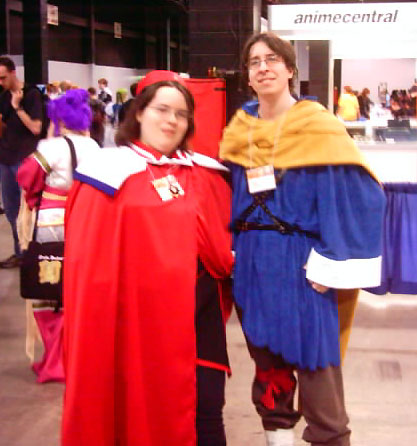
Was I studying for my finals this weekend? Hell no, I attended Anime Central on Friday and Saturday.
Brief Observations:
--Genshiken is a beautiful and interesting anime--I don't see it as simply a look at the "otaku lifestyle" of Japan, it's a study of masculinity for young men that aren't traditionally masculine. Definitely brings up difficult issues (like hentai) and good questions, with a backdrop of superb animation and humor.
--There seemed to be even more cross-playing this year. Lots of young teenage boys dressed up in Sailor Moon and Kagome costumes, very cute.
--I attended a shonen-ai panel: I really can't get into shonen-ai, but I learned a lot, specifically the differences between the perspective of western audiences versus eastern audiences. The best part was when a young gay man stood up and spoke out against top/bottom relationships--saying that they're insulting to homosexual relationships because such pairings are reduced to sex, and that they evoke traditional unhealthy heterosexual relationships where all power is placed on the masculine. (He received lots of applause from everyone at the panel.)

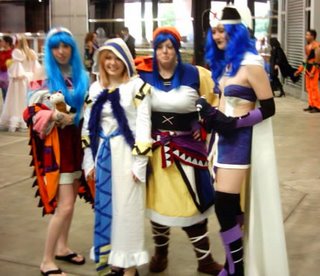
--I saw lots of Lunar cosplayers!
Wednesday, May 03, 2006
Focus on Women Please--An Update on the Activision Focus Group
My dream for years has been to tell the video game industry how I feel on a number of subjects, and here was my chance. The group consisted of about 7 guys in their 20s and 30s--all but one white. Good start huh? I was all fired up and angry at the fact that I had to go alone, and was ready to throw down some feminism right at their faces. When the questions started though, I calmed down a bit, but made sure to let them know that I really cared about the social messages of their product. They started out asking general questions: what's your favorite game, why do you like the X-men, ect. I tried to relay the point of how cool it is that the X-men are on the fringe of society, and that the basis of the comic is them fighting for their place in the world. They asked about characters within the game, and I pointed out how the X-men already have a diverse cast, and many strong, well established women characters. Raven doesn't need to do anything but put them in the game. I feel the first game had much better character choices, (why would I want to play as Toad?) and a larger amount of female mutants. Personally I would love to see Kitty Pride in a game, Raven studios is such a jerk for not putting her in.
After giving them a well thought out pitch for my own game, they started to pass out descriptions of possible game ideas that were actually being considered for production. They wanted our feelings on them, and let me tell you, most of them were terrible. The funniest and saddest was an X-men World War II game, where in an alternate universe, get this, Hitler won, so therefore communism?! Ruled the World, and Magneto somehow reigned as the supreme overlord. As Cable you would go back in time and kill Nazis with bullet time moves like in a Max Payne type shooter. What? So much of that doesn't make sense. The highlight of the afternoon, however, was the description of X-Men Femme Force. In this concept, Mystique releases a virus that affects all the male X-men leaving only the women left to stop her. Kind of a corny story, but having an all female mutant cast would be pretty cool. I read on though, and discovered a main part of the game would be to "dress up" your characters in different outfits, then it made a reference to DOA and claimed that the game would be just as sexy. Ouch. Costume changes are great, but the X-women aren't dolls, they're freedom fighters. To my surprise, I wasn't the first person to speak up. Two other people in the group informed everyone that their girlfriends were gamers and played the first two Legends along with them. They said that they were extremely disappointed that they couldn't come to the focus group. I also spoke up and related 100littledolls' plight. We agreed that we would play a game with an all woman cast. I then pleaded with them to not objectify these characters--I told them that it would be unnecessary and offensive.
As we were leaving, I heard the two guys in charge of the focus group talking to each other. They were surprised with the responses they were getting concerning women and games: "Wow, we really need to do a women's focus group..." F-ing Duh! But it's a start I guess. Overall, I tried to use this opportunity to also log my complaint of lack of originality in video games. Many of the game ideas presented to us were just rehashes of other popular games: Mercenaries with Wolverine, or Dynasty Warriors with X-men. Personally, if I wanted to play a game like Mercenaries, why wouldn't I just play Mercenaries, or Mercenaries II, whenever that comes out? The main issue with superhero games is that they have never established their own genre, or niche. They have always just hopped on board to a preexisting series of games. The focus should not be to make a copy of a existing game, but to define what superhero games are and create a place for them in the industry. Take a risk! More often than not, it will pay off. Just look at Nintendo.
Saturday, April 22, 2006
My genitalia has nothing to do with being a geek.

I was invited to go to a focus group tomorrow for the new X-Men game. I was all set: tonight I've been playing X-Men: Rise of the apocalypse, and I've also started to plan what games or anime I was going to buy with the hundred bucks I was going to make. Then I was called by the person who invited me with the information that I couldn't come because I'm a woman. Immediately, I was pissed. I asked why it mattered. His only explanation is that focus groups are split into age groups, therefore the groups are also split by gender. He then wondered how many women could there be that are interested in gaming and the X-Men? How many women do I personally know that game? I could only respond that while I only know a few women in real life that game, I know they're out there. I know that from blogs I read. (Besides, I live in fricken Chicago--there's a lot of women here.)
I asked if there's going to be focus group for women and he wasn't sure. I'm sending Shion's Glasses in my place--he promised to find out if there will be a separate group for women, and if there isn't, to give them hell in my honor. Hopefully, either way I'll convince him to post his experience up here.
It's annoying that I won't be getting the cash, and it's aggravating that my voice won't be heard. But the worst feeling is that this is all because of the attitude that women and men are completely different, which in turn fuels the gender gap in gaming in terms of perception and representation. I know that biologically there are differences between men and women, such as the fact that symptoms for a heart attack in women are different than that of men--but we're gamers. It's a hobby, an interest. If everything, especially video game marketing, keeps focusing on the differences between men and women, we're not going to get anywhere.
Update: I found out that there won't be any focus groups dedicated to female gamer's interests.
Update #2: per zeldasrevenge's suggestion here is Activision's mailing address:
Sunday, April 09, 2006
Androcentrism to the Xtreme

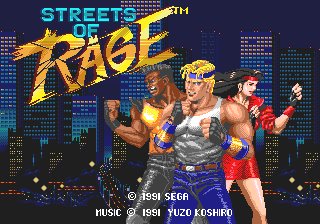
Tekanji's post, "Girl' Gamers Not Welcome," has inspired me to write about my own experiences growing up as a geeky gaming girl. I want to focus specifically on gaming, but I want to say that I’ve found this to be true in regards to comic books and anime as well. When I was younger, I always would watch my brother play games: the King's Quest series, the remake of the first Hero's Quest, Sonic the Hedgehog and Flashback. It wasn't until we got a Sega CD that we started playing together. At this point we never competed against each other, we’d played co-op. One of my favorite memories is of us beating Streets of Rage together; it was the ultimate achievement after so many hours of watching him play.
When my brother bought Brutal for the Sega CD, we started to play against each other. I couldn't keep up. He would always beat me, which made me frustrated to no end. I kept on wondering if it was because I was younger? Because I was a girl? Fighting games, unfortunately, became my brother's favorite genre. As a last attempt, I personally saved up my allowance in order to buy Popful Mail and Lunar 2 so that we could go back to what it was like before. However, my brother was becoming increasingly busy with school and extracurriculars, so after we beat those games, that was it. I'd replay games by myself, but stopped reading EGM, and I stopped looking for new games for us to play together. From the end of middle school to the end of high school, I became a spectator of everything videogame-related. It bothered me, but I kept quiet knowing that because I was out of practice I wouldn't be able to compete with any of my guy friends. It didn’t help that they never thought that I’d be interested in playing. (Plus, so much of the time, they'd play sports games. Gross.)
Around this time I began to collect comic books and anime in order to satisfy my geeky nature, but by the time I reached high school, I dropped them for fine arts and poetry. No lowbrow culture for me, thank you. I think I did this because I had no one to relate to in fandom, while in art I had Frida Kahlo and in poetry I had Sylvia Plath and Anne Sexton.
Everything changed when I met my current partner. A feminist ally and geek through and through, he was one of the few guy friends I had in high school who knew about my secret comic book obsession. As an avid gamer, he couldn't wait to get me back into gaming. Right away, I tried playing Mario Brothers on the GBA, which would only turn out nasty. Because I was so out of practice, I couldn't get anywhere. So we started out slowly, only playing co-ops and RPGs together: Champions of Norrath, the Dynasty Warriors games, and Xenosaga.
Videogames has now become an element in which has helped shape my identity to the point where I have the need to proclaim myself proudly as a woman gamer. I’m relieved that I realized that the reason I don’t like first person shooters or that I can’t play survival horror games without throwing the controller and shrieking has nothing to do with my gender or sex and everything to do with my personality.
Yet, a lot of my frustration still exists. And it's not just because of the tendency towards poor representation of women in games. I have a Mario messenger bag that I wear everywhere. Because of this bag there have been times, such as when I’m attending a convention, when I've been asked to pose for a picture so that the photographer could prove to his girlfriend that girls actually like games and attend conventions. Sometimes before or after class I have guys come up to tell me that they're surprised—I don't seem like the kind of person who would play games.
It’s lonely to be a woman gamer. I’m tired of just talking about videogames with guys, especially when so few of them care of what I have to say about them. I hate the fact that when I go to with my partner to his family gatherings where all the guys gather around an Xbox360, they only play Call of Duty 2 (a game I loathe). That when my partner tells his family that a good present for me would be a used copy of Baten Kaitos or a boot disk for our Japanese Dreamcast, they automatically assume that either he’s joking or that he’s trying to get extra presents for himself.
I try to have parties where I have my poetry group come over to play. The women in the group never participate, claiming that because they've never played, they don't even want try, even after I promise to teach them. This speaks volumes: I think videogame culture is more alienating to women than most realize. It’s the combination of bad press that videogames receive, poor representations of women, and the attitude of gamers.
I really believe that we need to take a proactive approach to the issue of women and games. We write, we discuss, hell, some are going to put together a review site that discusses women’s representation in games. All of this is important and needed. But it’s also tiring as all hell.